
25 years later
some words on sarah kane. content warning: suicide.

“I hate the idea of drama as journalism, but when it comes to acts of violence, my imagination isn’t that fucking sick. I just read the newspapers.” — Sarah Kane
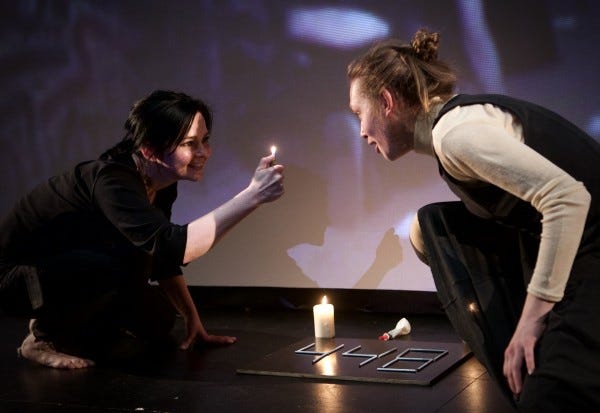
In the nearly forgotten villages around Minsk, an underground theatre troupe rehearses for the revolution under the last remaining dictatorship in Europe. The company is called Belarus Free Theatre (BFT), and the year is 2005. Alexander Lukashenko is about to win his third presidential term and people have questions, including the troupe’s co-founders Natalia Kaliada and her husband, Nikolai Khalezin. They are preparing to mount their first staged production underground in Minsk. The production is Sarah Kane’s final play: 4.48 Psychosis.
If you know anything about what’s currently happening in Belarus, then you know the situation hasn’t really improved since then. Belarusian authorities have continued to target journalists, lawyers, protesters, and activists in an effort to censor independent voices throughout the region. This is in spite of its Constitution, which claims to safeguard freedom of speech, but the country has detained hundreds of journalists on politically motivated charges.
"There is no official censorship law in Belarus," Kaliada told the BBC. "But Belarus authorities like to use [the] phrase 'not recommended.'"
In a 2019 report released by the Committee to Protect Journalists, Belarus was named one of the most censored countries in the world. Lukashenko has governed the nation with a self-explanatory “authoritarian style.” No human rights organization is able to operate legally in the country, and they live under constant surveillance if they offer any sort of assistance. It’s fucking horrible. VICE News traveled with some Belarusian journalists in 2017, and you can watch the full video essay here.
Khalezin witnessed these attrocities first hand as a top leading journalist, who worked for several publications before they were shut down by the government. He and his wife wanted to create something that would last, so they found permanence in the ephemeral.
Things quickly changed, however, when rehearsals were cut short by Lukashenko’s regime. The government banned 4.48 Psychosis because it addressed suicide, so they couldn’t present the play in public. Belarus has one of the highest rates of suicide in Europe, but they couldn’t stage the production because according to Kaliada, “it is not possible to talk about these things.”
But there’s that old adage phrase, “the show must go on” or whatever, and so it did. I say whatever because this phrase can be particularly harmful for disabled artists, but when you’re staging a play about disability to comfort disabled audiences, then yeah. The show must go on. And I’m grateful this one did.
Ahead of the performance, patrons had to call the company manager to pass along their contact information. Then, once the ensemble found a place to perform, the company would call them back with a secret location where the audience would gather before they were led into the venue. Audiences were encouraged to bring their passports with them, in case they were arrested for attending.
People like to say that Sarah’s work is unstageable, but this production really made you wonder if this story could ever be staged in Belarus. Or even, if it really ever should have been. The risk for this 70-minute performance, after all, was incredibly high. Why would anyone endanger their life for a play with no characters, “random” numbers, and Italian proverbs?
"Our audience in Belarus is the bravest in the world," Kaliada said. She was eventually proven right. More than 1,200 patrons came to see the show.
Whenever I think about this production, I’m constantly amazed by its permanency and resilience. I reflect on Sarah’s words, even when I can’t forgive them and especially when I want to forget them, but I don’t know if I could justify the risk. I don’t know if I could be that brave.
I’m writing about this now because today marks the 25th anniversary of Sarah’s passing and people often wonder why I care so much. Sarah died before I learned how to speak, and it’s not like I ever knew her personally. She’s a complete stranger to me and I’ll continue to say that over and over again, until the male academics in the room believe me.
I know it doesn’t make any sense. I could read other plays. I could work with other disabled artists. I could write about anything else. And at the same time, I can’t help but wonder if we’re still missing a central aspect of her work. We’ve aged a quarter of a century since her last solar rotation. Sometimes, it feels like she’s standing at the horizon, waiting for us to walk through, and we’re just staring back at her blanklessly.
Every once in awhile, I catch myself moving through these impenetrable cycles of grief for someone I never met, and I wonder how that’s possible. It feels like commodification because it is commodification, but I’m nevertheless devastated that she’s no longer with us. I also wonder if I have a right to be. But then again, I remember Spalding Gray and Antonin Artaud and Susan Harling. I cry whenever I think about Z’ane and feel guilty as I walk past the Hamilton marquee. I remember these amazing artists — how they’re all gone and how we could have done so much more to “save” them. Nobody is at fault and yet, at the same time, I still feel responsible for an industry that I wasn’t alive or conscious enough to change.
After she passed away, so many people were scared that we’d contaminate her legacy with Plathian comparisons. For good reason, too (see the above). Sarah’s words have been sent in online suicide forums. They’ve encouraged people to commit the unspeakable. Sarah spoke about her responsibility to the truth, despite how difficult it could be. And while I know this can be difficult to imagine, it’s also the truth. We owe her that much.
Simultaneously, those same words have saved my life and countless others too. I remember reading Crave at nineteen, when my throat constricted at the sound of his name, and I couldn’t believe someone wrote this in 1998. I remember thinking about 4.48 when I slept in the hospital, or barely slept in the hospital, and how hospitals have barely changed at all. I felt a strange and sickly sort of kinship with Sarah in that moment. I knew what she meant, but it was like I finally understood what she meant. I remember staring at Sarah’s unpublished manuscripts in November, how “21/247/10/15” (sorry! you’ll have to visit the University of Bristol to figure this one out!), and it really did. I remember listening to Sarah’s interview with Dan Rebellato, after losing my fellowship and graduation ceremony within the same week, and I learned how to laugh again. I realized that if Sarah could laugh in a classroom, then joy can coexist with sorrow and so on.


I’ve heard so many people share similar stories about her work. She’s inspired Broadway plays, literary masterpieces, award-winning TV shows, teen girl revenge fantasies, and so much more. Her contributions can’t be measured because they’re bigger than any of us can imagine. I still see her now in that one-woman-show running in the East Village, in that Olivia Rodrigo song playing over the credits, and in that apocalyptic painting by David Alfaro Siqueiros, which is currently on display at the Tate. A woman writing about her disability did that, and I can’t help but feel motivated to do the same.
I should clarify that Sarah would have likely disdained my interpretation of her work. She couldn’t even call herself a feminist at the time, so I doubt that she would have welcomed disability into the conversation. But her work has always dealt with the extreme, and the extreme feels very disabled to me.
This extremity becomes apparent when your proximity to mortality has been tested. It’s the kind of thing you experience when you have an anxiety attack and then return to class ten minutes later. Everything is back to normal, but your body is still catching up with your mind and life feels a bit unbalanced for awhile. You look the same. Your environment looks the same. So why do you feel at odds with everything else? I don’t know if that makes sense. Maybe only some of you will understand. Maybe that’s okay.
When it comes down to it, I don’t know how Sarah wanted to be remembered. I’m not here to resuscitate the dead because she’s already gone. But I bring up the BFT production because I wish in some sick and nonsensical way that I could tell her about it. Sarah was a political writer with strong convictions. She dramatized the Bosnian War in Blasted for a reason. People seem to forget that, but Belarus Free Theatre never did and I know that I never will. I think she would have been proud of that.
I hope that someday, we’ll surpass the horizon.
To watch a clip from Belarus Free Theatre’s production of 4.48 Psychosis, please click here.